


What is thatch?
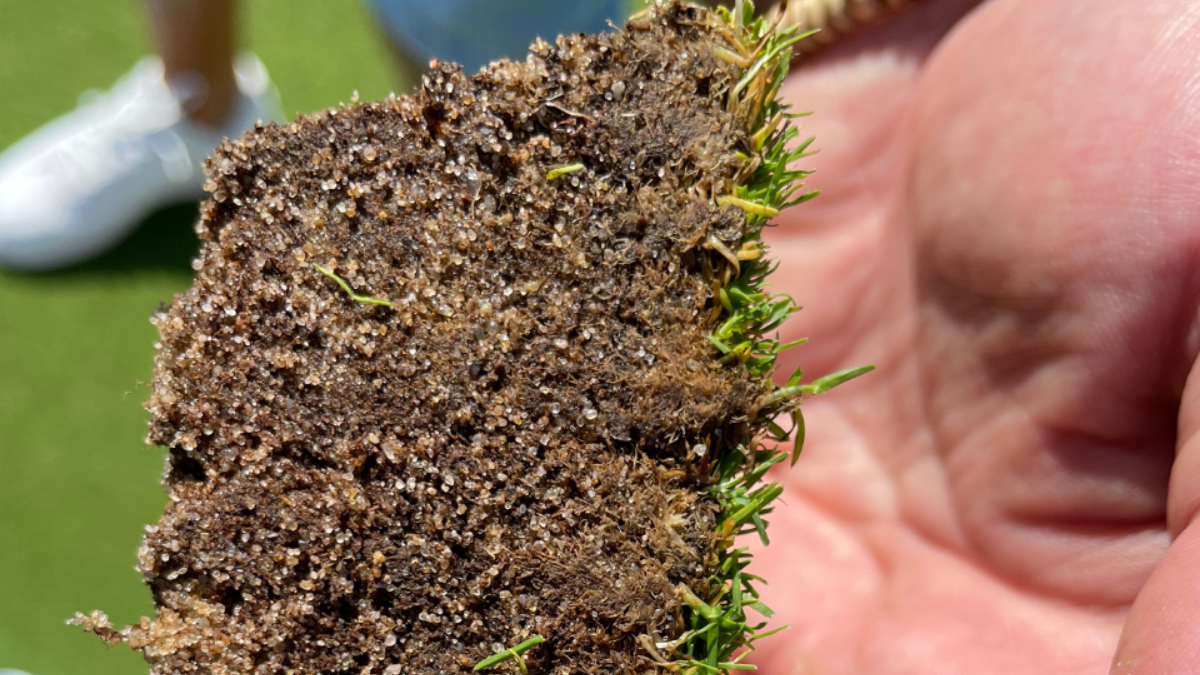
Why is thatch a problem?
All those problems have in common that the building of layers and the spongelike qualities of thatch hinder the infiltration of water and nutrients into the soil profile. In this spongelike layer, pathogens can lay dormant and easily attack the turf plant whenever it is weakened. You end up with a layer full of nutrients and water on top, and it’s very hard to encourage roots to go deeper searching for those essential elements.
Shallow rooting leads to a very low potential of the plant to regenerate after stress or disease, it can easily dry out and can be damaged, for example by maintenance work like aerification. Secondary damage by birds or mammals searching for larvae in the soil can be more severe.
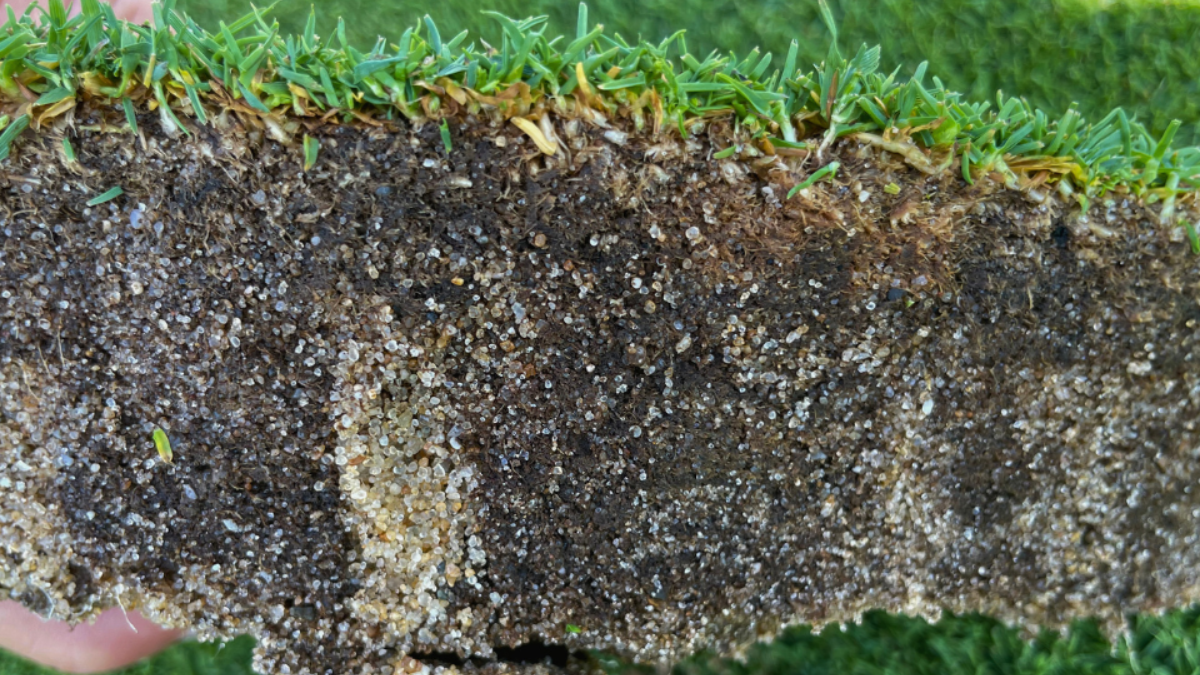
What is total organic matter (OM)?
It describes the total organic matter in the soil. It can be divided into three categories:
-
Living biomass of microorganisms
-
Fresh and partially decomposed plant residues (including thatch)
-
Well-decomposed and highly stable organic material (like humus and humic acids)
Organic matter in the rootzone includes the thatch layer on top but also all the living plant material like roots and shoots as well as decomposed organic materials like humus. The word humus is not always used consistently. Humus is sometimes used as a synonym for OM.
In a specific organic matter evaluation, roots and thatch remain in the sample and are included in the organic matter. Often the tests are done in a variety of depths 0-20 mm, 20-40 mm, 40-60 mm and 60-80 mm.
What is soil organic matter (SOM)?
In routine nutrient soil tests, usually, after the sample is dried at a temperature not greater than 30 °C it is sieved to pass a 2 mm screen, excluding stones and fibrous material like undecomposed living and dead plant material from roots and thatch. What is referred to as OM in standard nutrient soil test often means SOM.
How to measure organic matter?
The organic matter in the rootzone is measured by loss on ignition (LOI). Depending on the specific Lab method, LOI measures the weight of an oven-dried soil sample before and after burning its organic matter for 2 hours at 360 °C, with the loss in weight expressed as a percentage.
How to measure thatch?
Take a soil profile, identify the thatch layer directly on top of the soil. Measure the thickness. More than 12 mm of thatch, depending on the use of the playing surface, can be a problem.
How to control thatch?
-
Hollow coring
-
Verticutting
-
Sand topdressing
-
Increase microbial activity
-
Enzymes
-
Enzyme producing fungi and bacteria
Excess thatch levels can be reduced by cultural practices like hollow coring and verticutting, but it could be shown that one of the most effective practices to control thatch levels is to use sand topdressing regularly. Some turf managers go to the extreme and use regular, light topdressing as the sole cultural practice to control organic matter and thatch in the rootzone.
Increased microbial activity in the soil can increase thatch decomposition as well. Microbial activity is promoted by avoiding compaction and all cultural practices that increase oxygen levels in the soil.
Research has shown that the use of the enzyme cellulase can accelerate thatch decomposition short term, breaking down cellulose in the thatch. But it is much harder to break down lignin.
How to decompose lignin?
The word lignin is derived from the Latin word ‘lignum’ meaning wood. Lignin is a highly complex and rigid polymer found in plant cell walls, making it difficult to degrade. Its irregular shape and hydrophobic nature protect plants from microbial attacks.
Turf contains high amounts of lignin. The presence of lignin protecting the cell walls will prevent further decomposition.
Newer studies have shown that fungal produced laccase enzymes can effectively reduce thatch and have a long-term effect. Sidhu et al. could show 2013 in a greenhouse trial that over 6 months organic matter contend in the top 2.5cm of a Agrostis stolonifera rootzone was reduced by 24.7% and the thatch layer thickness was reduced by 57.2% (Sidhu, S., Huang, Q.J., Carrow, R.N., Jesperson, D., Liu, J., & Raymer, P.L., (2022). A review of a novel enzyme system for the management of thatch and soil water repellency in turfgrass. International Turfgrass Society Research Journal,14, 450-461. https://doi.org/10.1002/its2.138).
Fungi in TourTurf® Thatch-Less® FTD Fungi Thatch Degrader produce a wide variety of enzymes, among them strong lignin specific enzymes. It looks like lignin degrading enzymes can loosen the cell wall structure of death plant material and allow microorganisms to decompose the structural sugars in the cell wall substances cellulose and hemicellulose.
It has been shown that laccase can reduce Soil Water Repellency (SWR) in turf rootzones as well.
The updated formulation of Thatch-Less® ETD adds ready-made enzymes to the soil profile that start the degradation of organic matter in the thatch immediately. The high content of laccase breaks the strong chemical connections of lignin in old roots, stems and cell walls. This makes the cellulose more vulnerable to the cellulase enzymes that will break down cellulose and hemicellulose.
The laccase starts the process, cellulase can break down the cellulose and bacteria, fuelled by carbohydrates and seaweed extract, can continue the decomposition. The trial was done without oxygen under anaerobe conditions. The decompositions will work even better with enough available oxygen.
Program for thatch and organic matter control
If the overall OM is getting too high, but thatch is not really a problem, just increase topdressing slightly to reduce soil organic matter over time.
Regularly use a combination of cultural practices like aerification, verticutting and sand topdressing to thin out thatch, increase the water infiltration rate and harden the playing surface.
During the growing season, use those additional products to encourage the biological decomposition of death plant material:
-
TourTurf® MCB MolCarb – complex carbohydrates to improve microbial activity.
-
TourTurf® OXT Oxygen – increase available oxygen in the rootzone.
-
TourTurf® Thatch-Less® FTD – Enzyme producing bacteria and fungi to degrade lignin, cellulose, and hemicellulose.
-
TourTurf® Thatch-Less® ETD – Cellulase enzymes and cellulase producing microorganisms.
Microbial activity in the soil is temperature-dependent. Start the program as soon as you have a good soil temperature above 16 °C, and you can notice plant growth.
A typical program for thatch control, that can be adapted to the individual circumstances and soil test results, could be:
.png?width=800&height=255&name=Program_GB%20(1).png)
Thatch-Less® FTD contains soil fungi and should be premixed with hand warm water before adding to the tank-mix.
All products are tank-mixable, but mixability can vary depending on water quality and additional products added. As always, please do a jar test first to ensure compatibility of products.
If you make good use of all the available tools, you can manage thatch and prevent many turf problems.